
How to Read Japanese Mail and Notices: Deadlines, Bills & Important Words
Japanese letters can look intimidating, but most can be triaged quickly. Learn how to identify the sender, deadline, payment, required action, suspicious requests and when to contact the issuing organization.

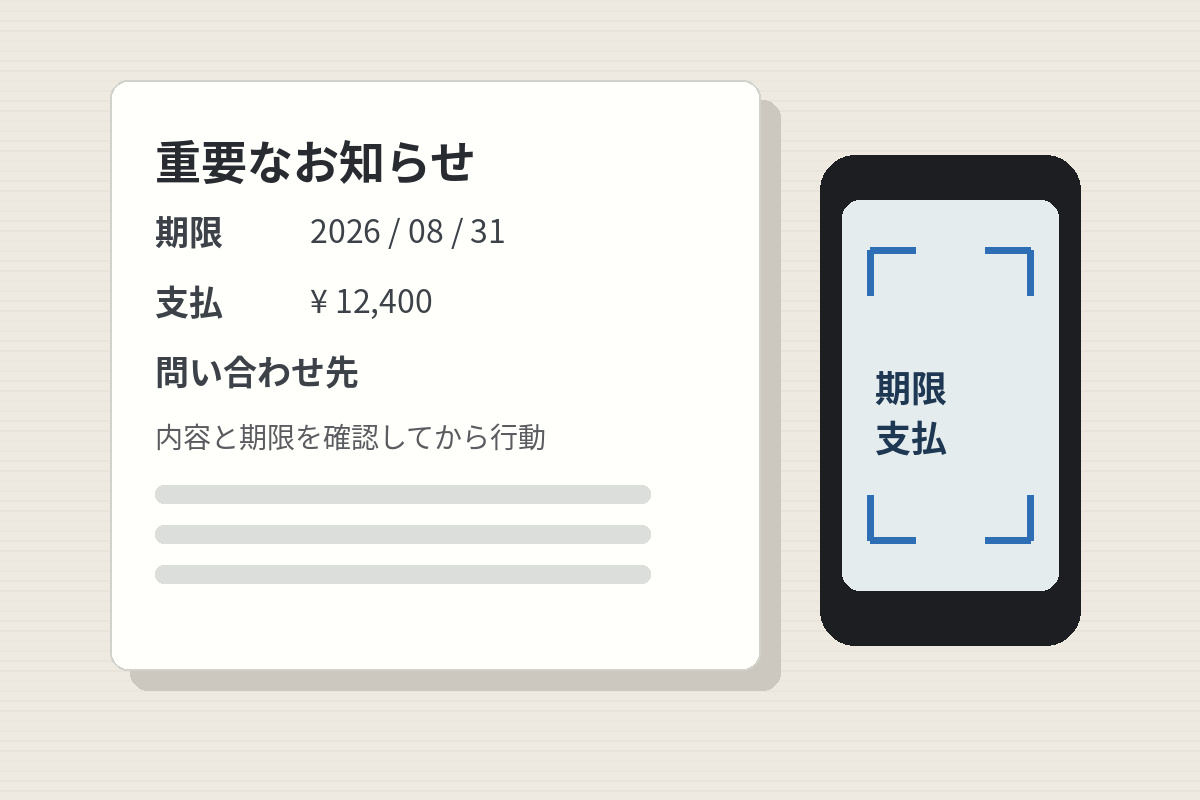
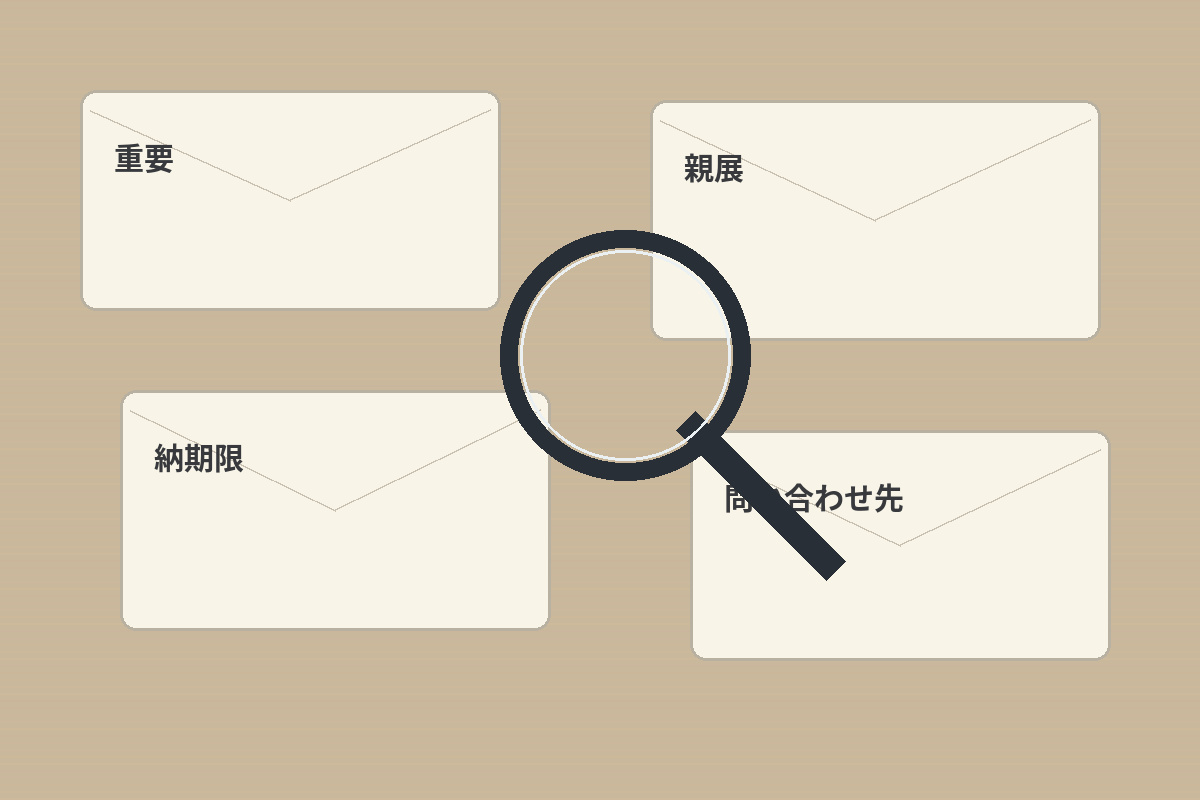
Do not translate a Japanese letter from top to bottom first. Start with five checks: who sent it, what the main heading says, the deadline, any amount due, and the action requested. Look for words such as 重要 (important), 期限 or 納期限 (deadline), 支払 or 納付 (payment), 提出 (submit), 返送 (return by mail), and 問い合わせ先 (contact). If the notice concerns tax, residence status, insurance, pension, court action, debt, medical care, housing, or a large payment, verify the details with the issuing organization through a contact channel you independently confirm.
Read the envelope and first page before translating everything
The fastest way to understand Japanese mail is to treat it as a task document. The sender, large heading, boxed information, dates, amounts and contact section usually reveal what the letter is about before you understand every sentence.
Keep the envelope. It can show the sender, postmark, delivery method and whether the item was addressed correctly. If the name is not yours, do not use the contents as if they were your own; contact the delivery service or sender for the appropriate handling method.
- Sender: organization name, department and return address.
- Purpose: the largest heading and repeated words.
- Deadline: dates next to 期限, 締切, 納期限, 提出期限 or 必着.
- Money: amounts next to 金額, 請求額, 納付額, 合計 or 円.
- Action: pay, submit, return, contact, attend or keep.
Learn the Japanese words that reveal urgency
You do not need advanced Japanese to spot the words that change what you should do next. Search for these terms visually first, then translate the surrounding sentence.
Polite Japanese can sound softer than the actual obligation when translated literally. A sentence connected to a due date, payment slip, return envelope or official form should be treated as potentially actionable until you confirm the meaning.
- 重要 — important.
- 親展 — intended for the named addressee to open.
- 至急 — urgent.
- 期限 / 締切 — deadline.
- 納期限 — payment deadline.
- 必着 — must arrive by the stated date.
- 納付 / 支払 — payment.
- 督促 — reminder or formal demand after non-payment.
- 提出 — submission.
- 返送 — return by mail.
- 問い合わせ先 — contact point.
Separate the issue date from the real deadline
A notice may show several dates: the issue date, payment deadline, appointment date, application period or validity date. Do not assume the most prominent date is the one that matters.
Some government documents use Japanese era years. If a date uses an era name rather than a Western year, confirm the conversion before calculating how much time you have. Also distinguish 必着, where the document must arrive by the date, from wording that allows the postmark date.
- 発行日 — issue date.
- 納期限 — payment deadline.
- 提出期限 — submission deadline.
- 有効期限 — expiration date.
- 必着 — document must arrive by the date.
- 消印有効 — the postmark date may be used for the deadline.
Identify which kind of sender you are dealing with
Sender type tells you what records and risks to check. City hall and other public offices may send information about taxes, insurance, benefits, resident registration or certificates. Pension, tax and immigration-related notices can have statutory deadlines or financial consequences.
Private organizations send different signals. Banks, utilities, mobile carriers, landlords and guarantor companies may write about failed payments, identity checks, contract renewals, maintenance, service changes or security alerts. Compare the customer number, billing period and account details with records you already have.
- City hall or prefecture: resident services, local tax, benefits, health insurance and certificates.
- National agencies: tax, pension, immigration or other statutory procedures.
- Bank or card company: payment, identity, account or security matters.
- Landlord or management company: rent, renewal, inspection, repairs or building rules.
- Utility or mobile provider: bill, failed debit, contract or service notice.
- Hospital or insurer: appointments, claims, eligibility or payment.
Use camera translation safely and verify the critical fields
Camera translation is useful for finding the structure of a document, but it can misread small print, vertical Japanese, names, dates and similar-looking numbers. Translate the important fields separately instead of trusting one full-page result.
Before uploading a document to any translation service, hide information that is not necessary for the task. This can include your My Number, residence card number, bank details, account numbers, barcodes, QR codes, passwords and medical identifiers.
- Photograph every page in order, including attachments.
- Translate the heading, deadline, amount, action sentence and contact section first.
- Compare numbers manually with the original paper.
- Redact sensitive identifiers that are not needed for translation.
- For legal, medical, immigration or high-value financial matters, confirm the interpretation with a person or the issuing organization.
Handle payment slips without paying twice
A payment slip may sit inside a notice with several reference numbers. Confirm the sender, billing period, amount, due date and payment method before paying. If the letter says a bank debit failed, check your bank history and the relevant billing period before sending another payment.
Keep the receipt or digital confirmation. If you pay after a reminder was already produced, the reminder and your payment may cross in the mail, so a second notice does not automatically mean the first payment failed.
- Match the billing period and customer reference to your account.
- Check whether automatic payment already occurred.
- Confirm the due date and accepted payment methods.
- Keep proof of payment.
- Contact the sender before paying a duplicate demand.
Treat missed-delivery notices as a separate postal task
A Japan Post missed-delivery notice normally gives you the information needed to request redelivery or arrange receipt. Japan Post's official online redelivery form asks for the tracking or notification number shown on the notice.
Use the official Japan Post website or the contact information you independently verify. Keep the notice until you receive the item, especially if it is registered mail or another item that may contain an important official document.
- Find the tracking or notification number on the notice.
- Check the storage or pickup deadline printed on the notice.
- Use Japan Post's official redelivery or tracking channels.
- Do not assume an unsolicited SMS about a parcel is genuine merely because you are expecting mail.
Verify suspicious demands before scanning a QR code or paying
Scammers imitate government agencies and well-known organizations. The National Tax Agency warns about suspicious messages impersonating the tax authorities, and Japan Pension Service also warns about fake emails, SMS messages, websites and social-media accounts.
If a letter or message creates extreme urgency, asks for unusual payment methods, sends you to an unfamiliar website or requests sensitive credentials, stop and verify the organization independently. Do not use a phone number, QR code or shortened link as your only proof that the notice is genuine.
- Find the organization's official website independently.
- Compare the notice with your real account, contract or prior correspondence.
- Never provide passwords, PINs or one-time codes for verification.
- Be cautious with gift-card, cryptocurrency or unfamiliar bank-transfer demands.
- Keep the envelope, notice, screenshots and a record of any calls.
Know when to ask for help immediately
Do not wait for a perfect translation when the consequence of missing the deadline is serious. Contact the sender, a municipal multilingual support desk, your employer or school, or an appropriate qualified professional and ask what action is needed to preserve your position.
For consumer disputes or suspicious commercial demands, the Consumer Affairs Agency's Consumer Hotline 188 connects callers to a local consumer affairs center or consultation service. Check the agency's current information for service details.
- A deadline within the next few days.
- Residence status, immigration or departure procedures.
- Court papers, enforcement, seizure or formal objections.
- Tax, pension, insurance, rent or utility arrears.
- Housing cancellation or essential-service suspension.
- Medical appointments, test results or medicine instructions.
- A large or unfamiliar payment demand.
Use simple Japanese phrases to confirm the required action
When you call or visit the sender, you usually do not need to explain the whole letter. Start with the reference number, your name and the deadline, then ask one concrete question at a time.
If you need language help, say so early. Even when English support is unavailable, identifying the exact deadline and required action can prevent a notice from becoming a larger problem.
- この手紙の内容を確認したいです。 — I would like to confirm what this letter says.
- 何をすればいいですか。 — What do I need to do?
- 期限はいつですか。 — When is the deadline?
- 支払いは必要ですか。 — Do I need to pay?
- 必要な書類は何ですか。 — Which documents are required?
- 英語で説明できますか。 — Can you explain it in English?
- 通訳をお願いできますか。 — Can you arrange an interpreter?
FAQ
Can I rely on a phone translation app for an official notice?
Use it to understand the structure and ordinary wording, but manually verify names, dates, amounts, reference numbers and the required action. For legal, medical, immigration or major financial matters, confirm the meaning with the sender or appropriate human support.
What should I check first on a Japanese letter?
Check the sender, main heading, deadline, amount and action requested. Those five items usually tell you whether the letter is informational, requires payment, requires a reply or needs urgent help.
What does 親展 mean on an envelope?
親展 indicates that the contents are intended for the named addressee to open. Treat the letter as private and do not open it casually if it is addressed to someone else.
What if I already paid a bill but receive a reminder?
Compare the billing period, reference number, payment date and bank or receipt record. The reminder may have been issued before your payment was processed. Contact the sender before paying again.
How do I handle a Japan Post missed-delivery notice?
Use the tracking or notification number printed on the notice and follow Japan Post's official redelivery or pickup instructions. Keep the notice until the item is received and check any storage deadline printed on it.
What should I do if I cannot understand a government notice before the deadline?
Contact the issuing office immediately. Give your name, reference number and deadline, explain that you need language assistance, and ask what minimum action must be taken by the deadline.
Official References
Final Thoughts
Japanese mail becomes much easier when you stop treating every page as a translation exercise and instead identify the task. Find the sender, deadline, amount and required action first, protect sensitive information when using translation tools, and verify serious or suspicious demands through an independently confirmed official channel. A short call before a deadline is usually safer than ignoring a notice you do not fully understand.