
How to Apply for Permanent Residency in Japan: Requirements, Documents & Rule Changes
A practical 2026 guide to Japan permanent residence: eligibility routes, tax and pension checks, documents, guarantor, application steps, processing time, current fees, and major rule changes proposed for late 2026 and 2027.

Permanent residence in Japan is not granted automatically after a certain number of years. You must qualify under the standard residence route or an official exception, satisfy the applicable conduct, livelihood and national-interest requirements, and show proper compliance with taxes, pension, health insurance and immigration notifications. As of August 18, 2026, the current Immigration Services Agency guideline remains the February 24, 2026 version, but important changes have been announced or proposed for October 2026 and April 2027. Check the official Immigration Services Agency pages again immediately before filing.
What Permanent Residence Changes
Permanent residence is a status of residence with no fixed period of stay and no restriction on the type of activity you may carry out in Japan. You no longer need ordinary extensions of your period of stay, and changing employers or occupations does not require you to change your status merely because the new work is in a different field.
Permanent residence does not make you a Japanese citizen. Your nationality does not change, and you still have obligations under the Immigration Control Act, including residence-card procedures and address notifications. Permanent residents can also lose the status in limited circumstances provided by law, so approval should not be treated as the end of all immigration responsibilities.
- No ordinary period-of-stay renewal after permanent residence is granted.
- No activity restriction tied to a work-status category.
- Japanese nationality is not acquired.
- Residence-card and address-related legal duties continue.
Choose the Eligibility Route Before Collecting Documents
The first practical step is to identify the route that actually applies to you. The standard rule is continuous residence in Japan for at least 10 years, including at least five continuous years under a qualifying work status or a residence-based status. Time under Technical Intern Training or Specified Skilled Worker (i) does not count toward that five-year work-status portion of the standard route.
Several official exceptions shorten the residence requirement. A genuine spouse of a Japanese national, permanent resident or special permanent resident can generally use the family route after at least three years of marriage and at least one continuous year in Japan. A qualifying child can generally use a one-year residence exception. Long-Term Residents generally use a five-year route, while recognized refugees and persons recognized for complementary protection may also have a five-year exception under the current guideline.
Highly skilled foreign professionals may qualify more quickly. Under the current points system, a person who can prove at least 70 points may qualify after three years, while a person who can prove at least 80 points may qualify after one year, subject to the required historical-point evidence.
- Standard route: generally 10 years in Japan, including five years under a qualifying work or residence status.
- Spouse route: generally three years of genuine marriage plus one continuous year in Japan.
- Qualifying child route: generally one continuous year in Japan.
- Long-Term Resident route: generally five continuous years under that status.
- Highly skilled route: generally three years at 70+ points or one year at 80+ points when the official conditions are met.
Understand the Three Core Legal Requirements
The current guideline is built around three core requirements: good conduct, sufficient assets or skills to maintain an independent livelihood, and a finding that permanent residence is in Japan's interests. These are not reduced to a single score or one salary number.
The national-interest requirement includes the residence-history rules, proper fulfillment of public obligations, compliance with immigration-law duties, and holding the required period of stay for your current status. The Immigration Services Agency examines the record as a whole rather than only checking whether you have the right number of years.
For a spouse or child of a Japanese national, permanent resident or special permanent resident, the statute provides special treatment for the good-conduct and independent-livelihood requirements. That does not mean taxes, public obligations, identity evidence or residence-history requirements can be ignored.
- Good conduct.
- Stable, independent livelihood where that requirement applies.
- Permanent residence must be judged to be in Japan's interests.
- Route-specific exceptions do not remove every documentary or compliance requirement.
Check Your Current Period of Stay and the April 2027 Change
The current permanent-residence guideline requires the applicant to hold the longest period of stay available for the current status. Under the transitional treatment in effect during 2026, a three-year period is still treated as satisfying this point for permanent-residence screening.
The Immigration Services Agency has announced a final change for April 1, 2027. From that date, the actual longest period prescribed for the applicant's status will generally be required instead of automatically treating three years as the longest period.
A limited transitional rule applies to a person who holds a three-year period on March 31, 2027: if the permanent-residence decision is made within that period, the three-year period can be treated as meeting the longest-period requirement for the first such decision. Applicants filing near the transition should recheck the official notice because the exact dates matter.
- Do not assume a one-year period of stay is sufficient.
- Three-year periods remain subject to the announced 2027 transition.
- Check the period printed on your current residence card before filing.
Audit Taxes, Pension, Health Insurance and Immigration Notifications
Permanent-residence screening places heavy weight on whether public obligations were fulfilled properly and on time. A zero balance today does not necessarily erase a history of late payment. Review the exact look-back periods and documents listed for your eligibility route.
Check resident tax and any national tax obligations, public pension coverage and payment, and public health-insurance enrollment and premiums. Job changes are a common source of gaps: a period between employers may create National Pension or National Health Insurance obligations even if you were previously covered through an employer.
Also check immigration notifications. Changes of address, employer or affiliated organization, and certain changes in marital status can trigger statutory notification duties. If a required notification was late or missing, understand the record before filing rather than assuming it will not be noticed.
- Resident tax certificates and proof of payment for the required years.
- National tax records when required by the checklist.
- Pension enrollment and payment history.
- Health-insurance enrollment and premium-payment history.
- Required immigration notifications and address records.
Build the Correct Document Package for Your Route
Do not use a generic internet checklist as your final filing list. The Immigration Services Agency publishes different permanent-residence document pages for spouses and children, Long-Term Residents, ordinary work-status applicants, and highly skilled applicants. Start from the official page that matches your current status and eligibility route.
Common documents can include the application form and photograph, passport and residence card, a statement of reasons, resident record, employment or business evidence, income and tax certificates, pension and health-insurance evidence, documents proving the family or highly skilled route, guarantor materials, and the required agreement form. The exact list varies by route and household situation.
Japanese certificates often have freshness requirements. Order certificates late enough that they remain valid when you file, but early enough to fix mistakes. Keep a complete copy or scan of the exact package you submit so that you can answer later requests consistently.
- Use the route-specific Immigration Services Agency checklist.
- Check document issue dates and required look-back periods.
- Keep names, addresses and dates consistent across all certificates.
- Make a complete copy of the submitted package.

Prepare the Guarantor and Agreement Form Correctly
Permanent-residence applications generally require a guarantor form. The guarantor is not the same as a loan guarantor who becomes financially responsible for the applicant's debts. Use the current Immigration Services Agency form and provide the guarantor identification material requested by the official checklist.
The Immigration Services Agency also requires an agreement form for permanent-residence applications. By signing it, the applicant acknowledges the obligation to report material changes that occur while the application is under examination. Do not omit it because an older checklist or third-party article does not mention it.
If your circumstances change after filing, such as employment, family, address or other facts material to the application, follow the agreement and Immigration Services Agency instructions rather than waiting for the office to discover the change.
- Use the current official guarantor form.
- Include the guarantor identification document required for your route.
- Include the permanent-residence agreement form.
- Report material changes while the case is pending.
Submit the Application Step by Step
After you identify the route and finish the compliance audit, assemble the package in a logical order and submit it to the regional immigration office that has jurisdiction over your place of residence. The general permanent-residence procedure page lists weekday reception hours, but individual offices and procedures can have different arrangements, so verify the office before traveling.
At submission, keep evidence of what was filed and the application receipt or reference information. Immigration may request additional documents during examination. Respond by the stated deadline and make the response easy to audit: explain what each document proves and avoid sending conflicting versions without an explanation.
Do not make irreversible plans based on an expected approval date. A complete application can still require additional review, and permanent residence is discretionary even when the basic eligibility route appears to be satisfied.
- Identify your correct jurisdictional immigration office.
- Submit the route-specific package.
- Keep the filing receipt and a copy of every document.
- Respond promptly and consistently to additional-document requests.
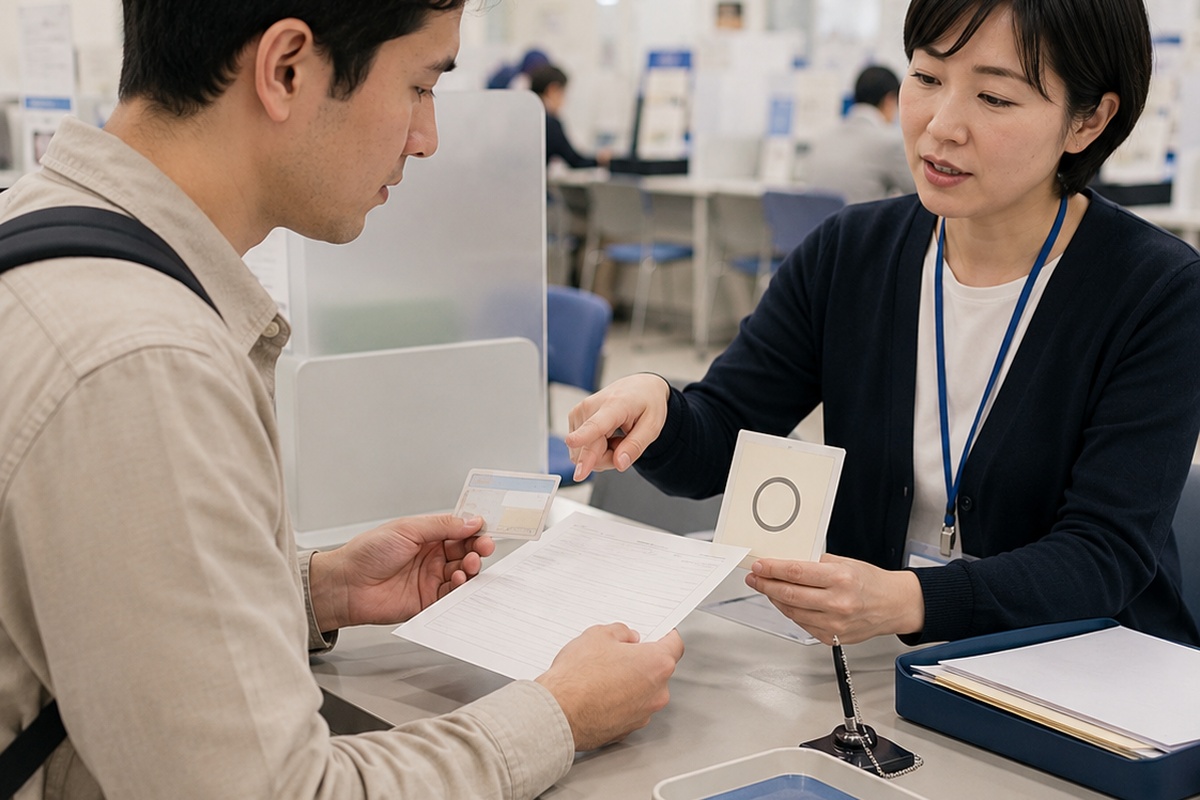
Keep Your Current Status Valid While the PR Case Is Pending
A permanent-residence application does not extend your current period of stay. If your current status will expire while the permanent-residence case is pending, file a separate extension application before the expiry date.
Continue to follow all conditions of your current status until permanent residence is actually granted. If you change employers, activities, address or family circumstances, complete any notification or status procedure that still applies to your current status and report material changes to the permanent-residence case when required.
Travel is not automatically prohibited while a permanent-residence case is pending, but your passport, residence status and re-entry arrangements still need to remain valid. Avoid being outside Japan in a way that could undermine the continuous-residence facts on which your application depends.
- Renew your current status separately when necessary.
- Continue all tax, pension, insurance and notification obligations.
- Keep immigration informed of material changes.
- Maintain valid re-entry arrangements for travel.
Processing Time and the Current 2026 Fee
The Immigration Services Agency lists a standard processing period of four to six months for permanent-residence applications. This is a standard, not a guaranteed completion date. Complex cases, incomplete evidence, office workload and additional inquiries can make an individual case take longer.
As of August 18, 2026, the official permanent-residence application page states that the fee is 10,000 yen, paid by revenue stamp when permission is granted. There is no permission fee simply for submitting the application.
A separate 2026 government proposal would raise the permanent-residence permission fee to 200,000 yen, with October 1, 2026 stated as the planned start date. The proposal also states that applications filed before October 1 would remain subject to the pre-change fee even if permission is granted later. Because this fee change was still presented through the official proposal/public-comment process when this guide was updated, verify the final rule before payment.
- Official standard processing period: four to six months.
- Current fee on permission: 10,000 yen as of August 18, 2026.
- Proposed fee from October 1, 2026: 200,000 yen, subject to final implementation.
- Recheck the official fee page when your result notice arrives.
August 2026 Draft Guideline: Separate Current Rules from Proposed Changes
On August 4, 2026, the Immigration Services Agency opened public comment on a draft revision of the permanent-residence guideline. This is important, but the draft should not be described as if every detail were already final. The public-comment period is scheduled through September 3, 2026.
The Minister of Justice stated that the draft would introduce a more explicit income benchmark based on the average for Japanese households and add a pension-related requirement. The stated plan is for the overall revised guideline to operate from April 1, 2027, with the income element starting from October 1, 2026.
The minister also stated that the new income treatment is intended to apply to certain applications filed from April 1, 2026 onward that are still pending on October 1, 2026. Because that timing could affect people who already filed, applicants with a pending case should monitor the final Immigration Services Agency announcement rather than relying on older advice saying that only the filing-date rules matter.
- Current legal guidance remains the official baseline until a revision is finalized.
- The August 2026 guideline revision is still a draft during public comment.
- Income treatment is intended to start earlier than the rest of the draft guideline.
- Pending applicants should monitor final announcements because transitional rules matter.
Common Risk Flags, Refusal and What to Do Next
A permanent-residence application becomes riskier when the record contains late taxes or social-insurance payments, missing pension periods, unreported immigration changes, unstable or poorly documented livelihood, inconsistent addresses or employment history, a period of stay that does not meet the guideline, criminal or traffic problems, or evidence that contradicts the claimed eligibility route.
Do not hide a difficult fact or submit an invented explanation. Organize the chronology, use official records, and explain unusual gaps honestly. If a problem can be corrected, first understand whether the issue is only documentary or whether a longer period of clean compliance is needed before refiling.
The official procedure page lists no administrative appeal method for a permanent-residence refusal. A refused applicant can still seek an explanation from immigration and may reapply after addressing the underlying issues. For a complicated history, a licensed immigration lawyer or certified administrative scrivener experienced in immigration filings can help you assess the evidence, but no representative can guarantee approval.
- Late public payments can matter even if the balance is now zero.
- Inconsistent or missing records should be explained, not concealed.
- A refusal does not automatically prevent a future application.
- No professional adviser can guarantee permanent-residence approval.

FAQ
Do I automatically qualify for permanent residence after 10 years in Japan?
No. Ten years is only the standard residence-history starting point. You must also satisfy the applicable legal requirements, public-obligation checks, period-of-stay rule and route-specific documentary requirements.
Is there an official minimum salary for permanent residence in Japan?
Under the current guideline, there is no single published yen amount that guarantees approval. Immigration assesses whether stable independent livelihood is expected in light of the household and evidence. In August 2026, the government published a draft guideline that would make the income benchmark more explicit; because that draft is still in the public-comment process, check the final version before relying on any salary figure.
Can I apply with a three-year period of stay?
During 2026, the current transitional treatment still treats a three-year period as satisfying the longest-period point. From April 1, 2027, the actual longest period for the status will generally be required, subject to the announced one-time transitional treatment for certain people holding a three-year period on March 31, 2027.
Can I change jobs while my permanent-residence application is pending?
A job change does not automatically cancel the application, but you must continue to comply with the rules of your current status, make any required employer or organization notification, and report material changes to the permanent-residence case when required. A major change can affect the livelihood or residence-history evidence under review.
Will paying overdue tax or pension immediately fix a permanent-residence problem?
Not necessarily. Immigration can consider whether public obligations were paid properly and by the required deadlines, not only whether the current balance is zero. Keep proof of payment and understand the compliance period before applying.
Do I still need to renew my current visa while permanent residence is pending?
Yes. A permanent-residence application does not extend your current period of stay. If it will expire before the permanent-residence decision, file a separate extension application before expiry.
How long does permanent-residence screening take and how much is the fee?
The official standard processing period is four to six months. As of August 18, 2026, the current permission fee is 10,000 yen. A separate official proposal would raise the fee to 200,000 yen from October 1, 2026, so recheck the final fee rule when your case is decided.
Official References
- Immigration Services Agency: Guidelines for Permission for Permanent Residence (revised February 24, 2026)
- Immigration Services Agency: Permanent Residence Application Procedure
- Immigration Services Agency: Permanent Residence Overview and April 2027 Period-of-Stay Notice
- Immigration Services Agency: Highly Skilled Professional Points Q&A
- Immigration Services Agency: August 2026 Public Comment on Permanent-Residence Guideline Revision
- Immigration Services Agency: 2026 Proposed Revision of Residence-Permission Fees
- Immigration Services Agency: Permanent-Resident System Reform Q&A
Final Thoughts
A strong permanent-residence application is built before the forms are printed. First identify the correct eligibility route, then audit residence history, taxes, pension, health insurance and immigration notifications, collect the route-specific evidence, and keep your current status valid while the case is pending. In 2026, timing matters more than usual because the April 2027 period-of-stay change is final and additional income and fee changes are being prepared for late 2026 and 2027. Use Settora as a practical checklist, but make the Immigration Services Agency's latest official page your final authority on the day you file and on the day permission is granted.